

Dear Reader,
In a market where fundamentals often take a backseat to frenzy, Beyond Meat (NASDAQ: BYND) has staged one of the most astonishing comebacks of 2025.
After languishing below $1 just a week ago, the stock has skyrocketed over 1,000%, fueled by meme stock momentum and a high-profile retail distribution deal.
But beneath the surface of this rally lies a deeper, more nuanced story—one that challenges conventional thinking about value, sentiment, and the future of plant-based investing.
Let’s unpack what’s really happening.
Counter-Narrative Insights:
The mainstream narrative is simple: Beyond Meat is a dying brand temporarily revived by meme stock mania. Analysts point to its declining revenues, mounting losses, and a saturated plant-based market. The consensus? This is a short-lived sugar high.

But here’s the counter-narrative: Beyond Meat’s rally, while speculative on the surface, may be the early signal of a broader shift in how retail capital is weaponized in distressed equity. The stock’s inclusion in the Roundhill Meme ETF (NYSE: MEME) wasn’t just a fluke—it was a catalyst that reactivated a dormant retail base, triggering a short squeeze that forced institutional hands.
This isn’t just about Beyond Meat. It’s about the evolving psychology of retail investors who now treat equities like options—high-risk, high-reward bets with asymmetric upside. In this light, BYND’s surge is less about fake meat and more about real behavioral finance.
So why now?
Three forces converged:
Short Interest as a Catalyst: As of mid-October 2025, BYND had a short interest exceeding 35% of float. When the stock was added to the MEME ETF, it triggered a reflexive loop—retail traders piled in, shorts scrambled to cover, and the price exploded.
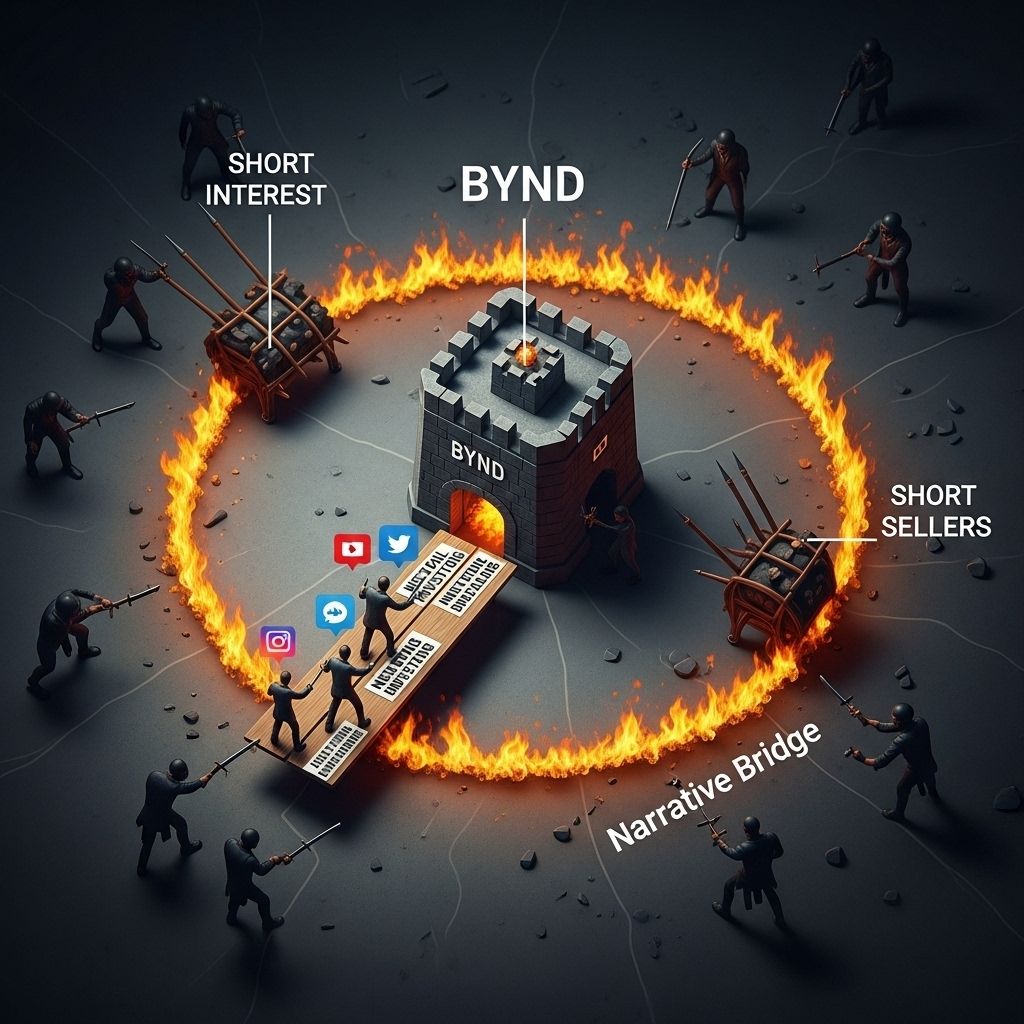
Behind the Trend

Narrative Arbitrage: Beyond Meat’s expanded deal with Walmart—placing its products in over 2,000 stores—offered just enough fundamental news to anchor the speculative frenzy. This created a narrative bridge between hype and hope.
Retail’s New Playbook: Post-GameStop, retail investors have learned to weaponize social media, ETFs, and short interest data. They’re not just buying stocks—they’re orchestrating liquidity events.
If this behavior persists, we may be entering a new era where distressed equities can be temporarily re-rated not by fundamentals, but by coordinated sentiment.
Real-World Examples & Case Studies:
Let’s compare Beyond Meat’s rally to two recent meme-driven surges:

GameStop (GME): In January 2021, GME surged over 1,600% in two weeks, driven by Reddit-fueled short squeezes. The stock eventually crashed, but not before forcing institutional recalibration of risk models.
Tupperware Brands (TUP): In July 2023, TUP jumped 500% in five days after retail traders latched onto its bankruptcy rumors and short interest. The rally faded, but it bought the company time to restructure.
In both cases, the rallies were dismissed as irrational. Yet they had real-world consequences—capital infusions, debt renegotiations, and brand revitalization. Beyond Meat may be following a similar script.
Supporting Data & Statistics:
• Stock Price Surge: BYND rose from $0.50 on October 17 to an intraday high of $6.73 by October 22, a 1,246% increase.
• Short Interest: As of October 16, short interest stood at 35.2% of float, per FINRA data. • Retail Participation: Trading volume on October 21 exceeded 300 million shares—more than 10x its 30-day average.
• Walmart Deal Impact: The new distribution agreement expands Beyond Meat’s footprint to over 2,000 Walmart stores, up from 800 previously.
These numbers aren’t just noise—they’re signals of a market structure increasingly vulnerable to sentiment-driven dislocations.
Actionable Frameworks & Overlooked Risks.
For investors and analysts, here’s a framework to assess similar setups:

Short Interest Threshold: Stocks with >25% short interest are primed for squeezes.
Narrative Catalyst: Look for news (even minor) that can be spun into a turnaround story.
Liquidity Spike: Watch for volume surges—early signs of retail swarm behavior.
ETF Inclusion: Monitor thematic ETFs like MEME, BUZZ, or YOLO for additions.
Overlooked Risk: The biggest danger isn’t the volatility—it’s the false sense of validation.
Companies like Beyond Meat may interpret speculative rallies as product-market fit, delaying necessary restructuring.
Investors must separate price action from business fundamentals.
Unanswered Questions & Future Implications
• Can Beyond Meat convert this speculative lifeline into operational turnaround?
• Will regulators step in to curb meme-driven volatility, especially in microcap equities?
• Are we witnessing the birth of a new asset class—“narrative equities”—where sentiment is the primary driver of value?
These questions will define the next phase of market evolution. For now, Beyond Meat is a case study in how capital flows, psychology, and narrative can collide to rewrite the rules of valuation.
In closing, Beyond Meat’s rally is more than a headline—it’s a mirror reflecting the changing face of modern markets.
Whether this ends in redemption or ruin remains to be seen. But one thing is clear: the retail crowd isn’t just back—they’re rewriting the playbook.
Stay tuned for our next issue, where we’ll explore how institutional investors are adapting to this new volatility regime.
Best regards,
Abdulla Al Noman
BzOPa News Pop